A power failure alarm detects when electricity stops at an outlet and warns someone. Some sound a siren in the room. Others send a text or email, and some do both. If nobody will be there to hear a siren, choose a design that can still notify you when the monitored property loses both power and WiFi.
A siren helps when someone is home to hear it. At an empty house, a basement freezer or a rental between guests, it helps no one.
That is why the phrase “power failure alarm” causes so much confusion. The same words describe a plug-in beeper, a cellular unit with its own service plan, and a WiFi device that reports to a server. Each one reaches a different person in a different place.
Outages are not rare, either. The US Energy Information Administration reports that customers averaged 11 hours without electricity in 2024, with major events such as hurricanes accounting for 80% of those hours. Interruptions not caused by major events average about two hours per customer per year. This guide helps you choose an alert that reaches you, wherever you are when that happens.
Table of Contents
What a power failure alarm is
A power failure alarm is a device that detects when mains power stops at a location and signals it, by sounding at the device, by sending a notification to a phone, or both.
In practice, “alarm” and “alert” get used as if they mean the same thing. They do not. An alarm makes noise where it sits. An alert travels to a person somewhere else. So the first thing to decide is which one you need.
| Type | How it tells you | Works when you are away? | What it needs | Main limitation |
|---|---|---|---|---|
| Local audible alarm | Siren or beep at the device, sometimes a light | No | A battery inside the unit | Only helps someone within earshot |
| Remote alert device | Text, email or app notification | Yes, if the alert path survives the outage | WiFi, a hub, a cellular plan or a server, depending on the design | How the alert gets out varies (see below) |
| Combination unit | Siren plus a remote alert | Yes, with the same caveat | Same as remote devices | Higher cost, and a siren you may not need |
| Utility outage alert | Notice from your electric company | Yes | An account with a utility that offers alerts | Reports the utility's grid, not your outlet or your breaker |
Where will you be when the power fails?

This one question sorts the whole category. Match the device to where you are likely to be, not to the loudest spec.
| Your situation | What you need | Why |
|---|---|---|
| Home and within earshot | A local alarm may be enough | You will likely notice, and you can act at once |
| Home and asleep | A local alarm, or a remote alert to your phone | A beeper in the basement may not wake you upstairs |
| At work or out for the day | A remote alert | Nobody is there to hear a siren |
| Traveling | A remote alert, plus a local contact | You need someone who can get to the property |
| Second home, rental or cabin | A cellular alert, or a server-heartbeat system that does not need the property's WiFi to stay online during the outage | The same outage usually takes the router down |
| Someone at home depends on powered equipment | A remote alert to a caregiver, plus backup power | A notification is not a medical alarm. It is one layer of a plan |
What to protect first
Start with the equipment that causes the most damage when it stops. That list is usually short.
| What stops | Why the timing matters | Reference point | Next step |
|---|---|---|---|
| Refrigerator | Food warms once the power is off | The FDA says an unopened refrigerator keeps food cold for about 4 hours | Know when the power went out, not just that it did |
| Freezer | Contents start to thaw | The FDA says a full freezer holds its temperature for about 48 hours, or 24 hours if half full, with the door closed | Plug the monitor into an outlet on the freezer's circuit. Then flip that breaker off and confirm the monitor goes offline |
| Sump pump | Most sump pumps stop when the power does, often during a storm | General guidance | Set up sump pump monitoring |
| Heating in winter | Most furnaces need electricity for their controls and blowers | The American Red Cross advises leaving heat on, set no lower than 55°F, when away | Watch indoor temperature remotely |
| Home network and cameras | The router, modem and cameras go dark | General guidance | Keep the home network reliable |
| Home medical equipment | Some devices need mains power to run | The CDC warns that long outages "can be life-threatening for people who depend on home-use medical devices" | Plan backup power first. Treat an alert as an extra layer |
Timing is the point. The FDA’s figures start when the power goes out. If you only find out when you get home, you are guessing. A remote alert with a timestamp turns that guess into a known start time.
How an alert gets out when the power is down

This is the question most buyers never ask, and the one that decides whether a remote alert works. If the power is out, the WiFi router is usually out too. So how does anything get sent?
There are three main designs. Each is legitimate, and each has a trade-off.
| Design | How it works | Strength | Trade-off |
|---|---|---|---|
| Device battery plus your network | The device keeps running on a small battery and tries to send the alert through your WiFi or hub | No service plan | The router and hub usually lose power in the same outage, unless they run on a backup supply |
| Cellular | The device has its own mobile connection, separate from your internet | Does not depend on your router or internet provider | Usually needs a service plan and cellular coverage at the property |
| Server-side heartbeat | While power is on, the device checks in with a remote server on a schedule. When the check-ins stop, the server sends the alert | The alert starts outside the property, so it does not need anything at the property to be working | It needs WiFi while power is on. A stopped heartbeat can also mean the internet dropped (see below) |
What a stopped heartbeat can mean
A heartbeat device reports that it has stopped checking in. It cannot tell the server why. A stopped heartbeat can mean:
- the power failed at that outlet
- the router stopped responding or the WiFi dropped
- the internet service went down
- the device was unplugged
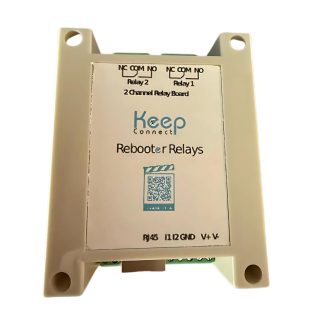
For that reason, treat an offline alert as “this device is offline” until you confirm the cause. When check-ins resume, the system can tell you the device is back online. A call to a neighbor, your utility’s outage map or a second device on another connection can tell you which one it was. If the router is the weak point, add router recovery, such as Keep Connect, which power cycles the modem or router when the internet connection drops while power is still on.
Utility outage alerts vs a device at your property

Many electric utilities, such as Duke Energy and PG&E, let customers sign up for outage alerts. They are worth turning on. Still, they answer a different question from a device on your outlet.
| What happens | Utility outage alert | Device at your property |
|---|---|---|
| What it watches | The utility's grid, as the utility sees it | Power at the outlet the device is plugged into |
| Breaker or GFCI trips and cuts power to the device | Not visible to the utility | Detected, because the device itself loses power |
| Breaker trips on a different circuit | Not visible | Not detected, unless the device is on that circuit |
| An appliance is unplugged, but the device still has power | Not visible | Not detected |
| Area-wide outage | Yes | Yes |
| Covers a property with a different utility account | Only if you enroll that account | Yes, wherever the device is installed |
Use both. The utility alert tells you about the grid. A device tells you about the circuit you care about, such as the one feeding a freezer or a sump pump.
What to check before you buy
Ask these questions of any power failure alarm, including ours.
- Does it need to be heard, or does it need to reach you? Decide between a siren, a remote alert or both.
- How does the alert reach you during an outage? Battery through your WiFi, cellular, or a server heartbeat.
- Does it send a restoration alert? Knowing the power came back tells you when to stop worrying, and what to check.
- Can you set the delay? A short flicker should not wake you at 3 a.m. A long outage should.
- Can the message name the property and the appliance? “Lake house freezer outlet offline” is more useful than “Device offline”.
- Does it need a hub? A hub adds hardware, and it needs power too.
- Is there a subscription? Check whether texts and emails cost extra, and what paid tiers add.
- How many contacts can it alert? A backup contact matters when you are on a plane.
- How is it set up? App, browser page or hub pairing.
How to set up and test outage alerts
- Pick the outlet. Plug the device into an outlet on the circuit you want to watch, such as the one feeding the freezer or sump pump. A device reports its own outlet’s power, not every circuit in the house, and not whether an appliance is still plugged in.
- Write the message. Name the property and the appliance, so the alert makes sense without a second look.
- Set the delay. Choose how long power must be off before you are alerted.
- Add a backup contact. Choose someone who can get to the property.
- Test the full path. Unplug the device, wait longer than your delay, and confirm the outage alert arrives. Plug it back in and confirm the restoration alert.
- Test again after changes. Retest after a new router, a new WiFi password or a changed phone number.
Where PowerPal and Power Pal MAX fit
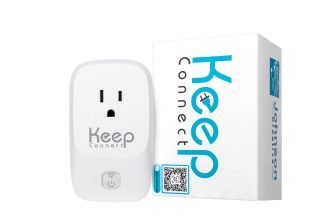
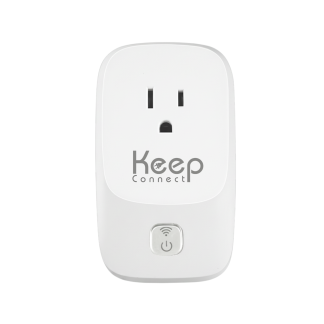
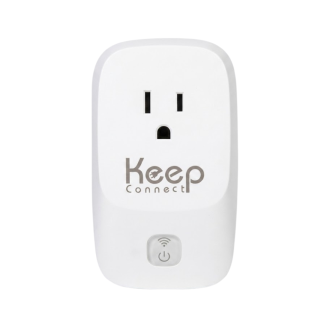
PowerPal is a plug-in power outage monitor made by Johnson Creative LLC. It uses server-side heartbeat monitoring to send SMS and email alerts when power is lost and when it returns.
According to the PowerPal product page, PowerPal:
- plugs into a standard outlet, with no electrician needed
- sends a heartbeat to Keep Connect servers while power is on, and the servers send your alert when it stops
- sends SMS and email alerts, free, with no per-message fees
- sends power-restored messages as well as outage alerts
- lets you set the heartbeat interval and how long to wait before an offline alert is sent
- lets you write custom alerts that name the property or appliance
- sets up through a browser-based page, with WPS supported and no app required
- needs no subscription, while optional Keep Connect Cloud Services add the mobile app, web dashboard and multi-location management
What PowerPal is not. It is not an audible alarm. No siren is listed on its product page, so if you want something that makes noise in the room, this is not it. It does not measure energy use, and it cannot restore power. It also needs a WiFi network to send its heartbeat while power is on. If you want to measure what your appliances use, see our guide to monitoring home electricity usage.
When Power Pal MAX makes more sense
Power Pal MAX sends the same outage and restoration alerts through the same heartbeat design. Its product page lists a 15A rating, a higher-capacity chipset, higher voltage compatibility and precision power metering for line health and voltage monitoring. Johnson Creative positions it for deep freezers, sump pumps, climate systems, vacation rentals, offices, server rooms, and industrial and renewable energy sites.
Where Rebooter Relays and Keep Connect come in
For an empty home, think in three layers:
-
Power
A power outage alert tells you when the property loses electricity.
-
Connection
Router recovery restarts a router that has power but stops responding.
-
Condition
A temperature and humidity sensor watches what the outage does to the space.
No single device covers all three.
PowerPal and Power Pal MAX send SMS and email alerts when their heartbeat stops and when it returns. Neither one sounds a siren or restores power.
Frequently Asked Questions
What is a power failure alarm?
A power failure alarm detects when mains power stops at an outlet and signals it. Some sound a siren at the device. Others send a text, email or app alert to your phone, and combination units do both. Choose a remote alert if nobody will be there to hear a siren.
How do I know if the power went out at my house while I was away?
Use a remote power outage alert on the circuit you care about, and sign up for your utility's outage alerts. The device reports power at its own outlet, including a tripped breaker on that circuit. The utility reports its grid. Together, those alerts help you work out what happened and approximately when.
Does a power outage alert still work when the WiFi is down too?
It depends on the design. A device that sends through your router usually cannot, because the router loses power too. A cellular device can, where it has coverage. A server-heartbeat device, such as PowerPal, can, because the server sends the alert when the device stops checking in. That alert tells you the device went offline. On its own, it does not tell a power failure apart from a router, WiFi or internet failure.
Do I need a hub or a subscription for power outage alerts?
Not always. Some devices need a hub, and many cellular units need a service plan. PowerPal needs neither. It connects to your WiFi, and its SMS and email alerts have no subscription or per-message fees. Optional Cloud Services add an app, a dashboard and multi-location management.
Will a power failure alarm tell me when the power comes back?
Many will, but check before you buy. A restoration alert tells you when to stop worrying, how long the outage lasted, and when to check equipment that may not restart on its own. PowerPal and Power Pal MAX both send restoration messages.
How long does food stay safe in a freezer without power?
The FDA says a full freezer keeps its temperature for about 48 hours, or about 24 hours if it is half full, as long as the door stays closed. An unopened refrigerator keeps food cold for about 4 hours. Knowing when the power went out makes these figures usable.
Is my utility's outage alert enough?
It is a good start, but it watches the grid, not your home's circuits. It will not see a tripped breaker, a tripped GFCI outlet or a blown fuse inside the house. A device plugged into the circuit feeding a freezer or sump pump covers that gap for that circuit.
Does PowerPal sound an alarm?
No audible alarm is listed on the PowerPal product page. PowerPal sends SMS and email alerts through Keep Connect servers. If you need a siren in the room, pair it with a local audible alarm, or choose a combination unit.
Choose the alert that reaches you
Decide where you will be when the power fails. Then pick the device whose warning gets there. Put it on the circuit you care about, name the appliance in the message, and test the whole path before you rely on it.
If a remote alert is the missing piece, see PowerPal. If you need a 15A rating or voltage monitoring, compare Power Pal MAX.