Your electric bill tells you what you used. It never tells you what used it.
The average U.S. home buys about 899 kilowatt-hours of electricity a month, according to the U.S. Energy Information Administration. Most homeowners cannot name the three appliances responsible for the bulk of that. Monitoring changes it in about a week.
This guide covers how to measure your home’s electricity usage, how to turn watts into a dollar figure you can act on, and one thing every usage monitor fails to tell you.
What Does It Mean to Monitor Home Electricity Usage?
Monitoring home electricity usage means measuring how much electricity your home or a single device draws with a dedicated meter, rather than relying on your monthly bill.
An electricity usage monitor reports two things: watts, the rate of draw at that moment, and kilowatt-hours, the total consumed over time. Utilities bill you in kilowatt-hours.
Your utility bill gives you one number for the whole house, once a month, after the money is spent. It cannot tell you which appliance drove the number up.
A monitor closes that gap. It shows draw as it happens and totals it over hours or days, so you can attribute cost to a specific device instead of guessing.
The distinction between watts and kilowatt-hours matters more than it sounds. A 1,500 watt space heater running ten minutes a day costs almost nothing. The same heater running eight hours a day is one of the most expensive things in your house. Rate alone tells you nothing. Rate multiplied by time is the bill.
The 3 Types of Electricity Usage Monitors
Three ways measure household electricity, and each answers a different question.
|
Monitor type
|
What it measures
|
Installation
|
Relative cost
|
Best For
|
|---|---|---|---|---|
|
Plug-in outlet monitor
|
One plugged-in device at a time
|
Plug it in, no tools
|
Lowest
|
Finding what a specific appliance costs
|
|
Whole-home CT clamp
|
Total electricity entering the home
|
Clamps onto service wires in the panel, electrician recommended
|
Medium
|
Total usage, trends, and time-of-use patterns
|
|
Smart panel or circuit monitor
|
Each circuit separately
|
Licensed electrician required
|
Highest
|
Per-room or per-circuit detail
|

Plug-in outlet monitors
A plug-in monitor sits between the wall outlet and the device. It reads only what passes through it.
This is the cheapest and most useful place to start. It answers the question most people actually have: “What is this one thing costing me?” The limitation is scope. It only reads what plugs into a standard outlet, which rules out your largest loads. Central air, an electric water heater, and a well pump are all hardwired.
Whole-home clamp monitors
A whole-home monitor uses current transformer clamps, usually called CT clamps, that fit around the main wires feeding your electrical panel. It measures everything entering the house.
You get a complete picture of total consumption and how it moves through the day. What you do not get, in most cases, is attribution. It tells you the house pulled 4 kilowatts at 7 p.m. It does not tell you which device did it. Some models attempt to identify appliances by their draw signature, with mixed results.
Installation means working at the panel. Hire an electrician.
Smart panel and circuit-level monitors
Circuit-level monitors clamp onto individual breakers, so each circuit is measured separately. This is the most detailed and most expensive option, and it requires a licensed electrician.
It suits people who want per-room data, have solar and need to track production against consumption, or are diagnosing a specific circuit problem.
Can you monitor electricity usage with a smart meter?
Sometimes, but with limits. Many utilities that have installed smart meters offer an online portal showing daily or hourly usage. Some meters also support a direct local connection to a compatible in-home display.
The catch is that utility portal data is usually delayed by a day or more, and it reports only the whole house. Availability and data granularity vary by utility, so check your provider’s website before buying anything else.
How to Monitor Your Home Electricity Usage in 5 Steps
Step 1. Find your electricity rate
Look at your utility bill for the rate per kilowatt-hour. It is often listed as a supply charge and a delivery charge that you need to add together.
Every calculation below depends on this number. Rates vary by utility, by season, and in many areas by time of day. If you are on a time-of-use plan, note the peak and off-peak rates separately.
Step 2. Start with your five biggest loads
Do not try to measure everything. Go where the money is.
The EIA’s Residential Energy Consumption Survey found that in 2020, air conditioning accounted for about 19 percent of home electricity use, with space heating and water heating at roughly 12 percent each. Lighting and refrigerators followed.
Start with heating and cooling, the water heater, the clothes dryer, the refrigerator, and any pump. Five measurements will explain most of your bill.
If you want the wattage figures behind those percentages, how many watts it takes to run a house breaks down typical draw by appliance and by whole-house load.
Step 3. Measure a full cycle, not a snapshot
This is the step most people skip, and it produces most of the wrong conclusions.
A refrigerator does not draw steadily. It cycles on and off. Catch it mid-cycle and you will record a number three or four times its real average. Catch it between cycles and you will record almost nothing.
Measure for 24 hours minimum. For anything seasonal, like an air conditioner or a heat pump, measure for a week. Use the monitor’s cumulative kilowatt-hour reading, not the instantaneous watt display.
Step 4. Convert the reading into monthly cost
Take the kilowatt-hours the monitor recorded, scale them to a month, and multiply by your rate. The formula is in the next section.
Step 5. Re-measure after every change
A single reading is trivia. Two readings are a decision.
Measure the device, change something, then measure again. Adjust the thermostat, replace the seal, move the second refrigerator out of the hot garage, then re-measure. The difference between the two numbers is the only proof that the change was worth making.
For more changes worth testing, see why your electric bill is so high and how to lower it.
How to Calculate What an Appliance Costs to Run
Use this formula:
(Watts ÷ 1,000) × hours used per day × 30 × your rate per kWh = monthly cost
Dividing by 1,000 converts watts to kilowatts. Multiplying by hours gives kilowatt-hours. Multiplying by your rate gives dollars.
Worked example. A device drawing 300 watts, running 6 hours a day, at an example rate of 16 cents per kilowatt-hour:
| Step | Calculation | Result |
|---|---|---|
| Convert to kilowatts | 300 ÷ 1,000 | 0.3 kW |
| Daily kilowatt-hours | 0.3 × 6 hours | 1.8 kWh |
| Monthly kilowatt-hours | 1.8 × 30 days | 54 kWh |
| Monthly cost | 54 × $0.16 | $8.64 |
The 16-cent rate is an example only. Use the rate from your own bill, because that is the only number that makes the answer true for your house.
For cycling appliances, do not use nameplate wattage. A refrigerator label shows peak draw, not average draw. Use the kilowatt-hours your monitor actually recorded over 24 hours, then multiply by 30.
What Your Electricity Data Will Actually Show You
Idle load is larger than most people expect
The Natural Resources Defense Council studied always-on devices that draw power while inactive, a category it called idle load. In the California homes it examined, idle load accounted for close to 23 percent of household electricity consumption. NRDC put the cost at roughly $165 per household per year on average, rising to as much as $440 for households on top-tier rates.
That study was published in 2015, and the sample was California homes, so treat the percentage as an indication rather than a national figure. The pattern still holds, and a monitor will show it to you directly. Measure a device you consider “off” and see what the display says.
A rising draw often means a failing appliance
This is the benefit nobody mentions when they sell you a monitor.
An appliance that gradually pulls more power than it used to is frequently working harder than it should. A refrigerator with a failing door seal runs longer. A pump with a worn bearing draws more current. A clogged dryer vent extends every cycle.
You only see this if you have an earlier reading to compare against. Record a baseline now, even if nothing seems wrong. It is worth more in a year than it is today.
Usage has a seasonal shape
One month of data is not a baseline. Cooling and heating loads swing sharply between seasons, so comparing July to October won’t tell you anything useful.
Compare like seasons. July against last July.
The Blind Spot Every Electricity Usage Monitor Has
An electricity usage monitor measures electricity that is flowing. When the power goes out, there is nothing left to measure, and the monitor goes dark along with everything else in the house.
It will not tell you the power failed. It will not tell you when it came back.
For most people that gap does not matter until it does. A freezer full of food does not need you to know its wattage. It needs you to know it stopped running six hours ago. The same is true of a sump pump before a storm, a home office, a well pump, and the router that everything else depends on.
If you are away from the property, you have no way to know at all.
Covering that gap takes a different kind of device entirely. A power outage notification device does not measure consumption. It watches whether power is present and tells you the moment that changes, which is a separate function that no usage monitor performs.
Which one do you actually need?
|
Your goal
|
What you need
|
|---|---|
|
Lower my electric bill
|
Electricity usage monitor
|
|
Find which appliance costs the most
|
Plug-in usage monitor
|
|
Catch an appliance that is failing
|
Usage monitor, with a recorded baseline
|
|
Know the instant the power goes out
|
Power outage notification device
|
Most households only need the first three. If you are protecting something that spoils, floods, or must stay online, you need both kinds, because neither does the other’s job.
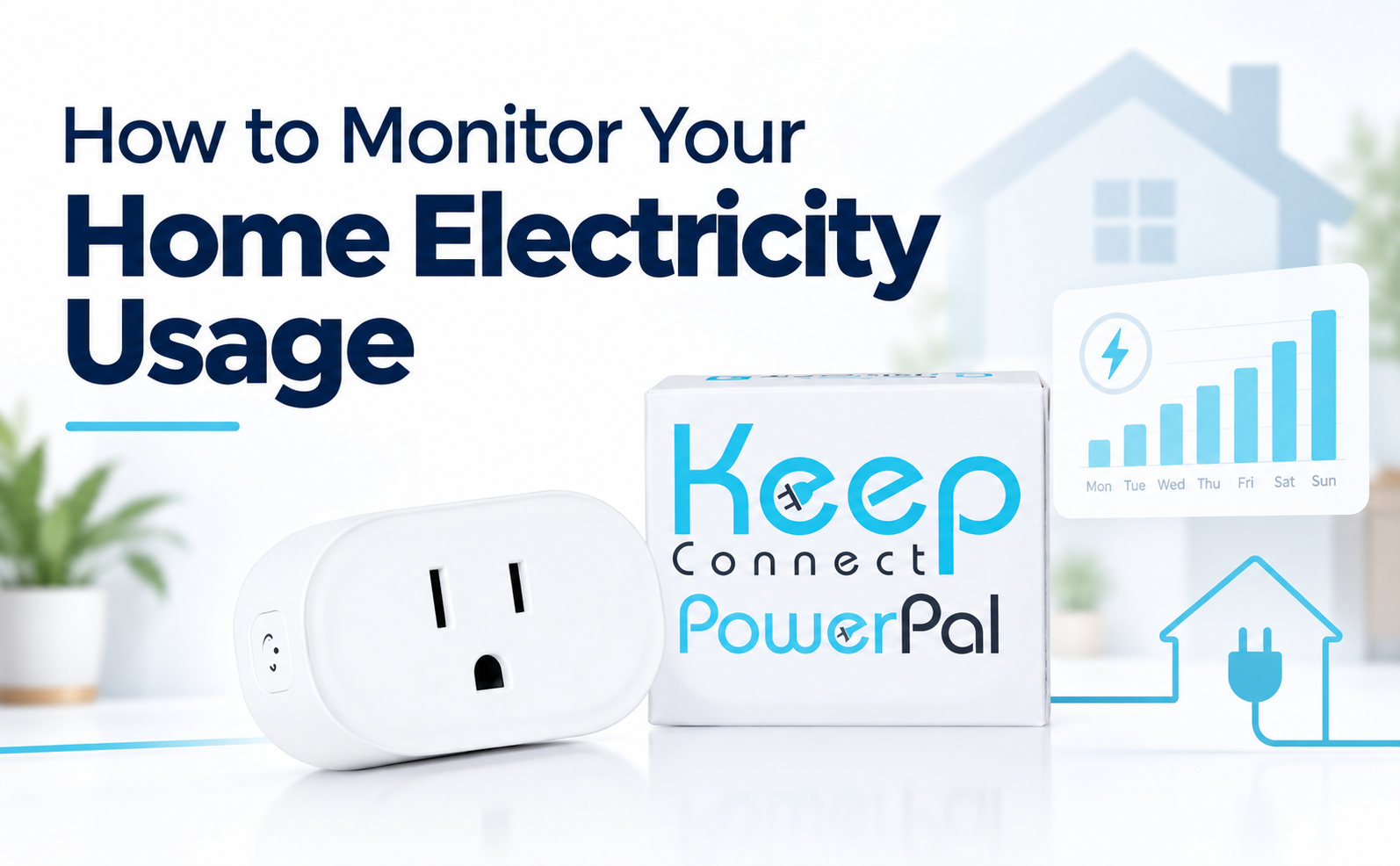
PowerPal by Keep Connect
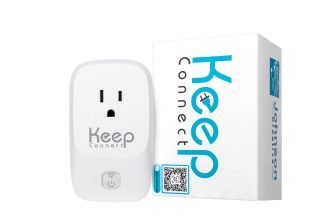
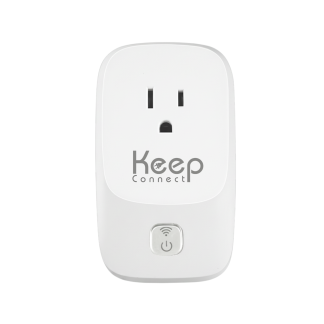
PowerPal by Keep Connect is a power monitoring device that plugs into any standard outlet. It monitors power at that location and sends an SMS or email when a power outage occurs, and again when power is restored.
To be clear: PowerPal is not an electricity usage monitor. It does not measure watts, kilowatt-hours, or what anything costs to run.
It covers the other half of the picture: knowing whether the power is on at all.
Frequently Asked Questions
How can I monitor my electricity usage at home?
Use a plug-in monitor for individual appliances, a whole-home clamp monitor for total household consumption, or a circuit-level monitor for per-circuit detail. Start with a plug-in monitor on your largest plug-in loads, measure each for at least 24 hours, then multiply the recorded kilowatt-hours by your utility rate to get a monthly cost.
Is there an app to monitor electricity usage?
Many electricity monitors include a companion app that shows real-time and historical usage. Separately, a number of utilities offer their own app or web portal showing daily or hourly household usage from a smart meter, though that data is usually delayed and covers the whole house rather than individual devices. Check your utility’s website first, since that option costs nothing.
How accurate are plug-in electricity usage monitors?
Consumer plug-in monitors are accurate enough for comparing devices and estimating costs, though not to utility-meter standards. Accuracy drops on very low draws, which matters when measuring standby power. The bigger source of error is usually measurement time, not the meter. Measuring a cycling appliance for a few minutes instead of a full day will skew the result far more than the device’s own tolerance.
Can I monitor electricity usage without an electrician?
Yes, with a plug-in monitor. It requires no tools and no wiring. Whole-home and circuit-level monitors install inside the electrical panel and should be fitted by a licensed electrician. Plug-in monitors cannot read hardwired loads such as central air conditioning, an electric water heater, or a well pump.
Can you monitor electricity usage by room or by circuit?
By circuit, yes, using a circuit-level or smart panel monitor that clamps onto individual breakers. By room, only if your wiring happens to follow room boundaries, which is common but not guaranteed. Check your panel’s circuit labels before assuming a circuit maps to one room.
Will an electricity usage monitor tell me if the power goes out?
No. An electricity usage monitor measures electricity that is flowing, so when power is lost it loses power too and stops reporting. It will not alert you to an outage or tell you when power returns. That requires a power outage notification device, which monitors whether power is present and sends an alert when it changes.
Act on What the Data Shows
An electricity usage monitor tells you what your home is using. It cannot tell you when your home loses power.
PowerPal by Keep Connect plugs into any standard outlet and sends a free SMS or email the moment power is lost, and again when it returns. No subscription. No app required.