 Written by Rona Sabatin
Content Writer, Johnson Creative · Updated
Written by Rona Sabatin
Content Writer, Johnson Creative · Updated
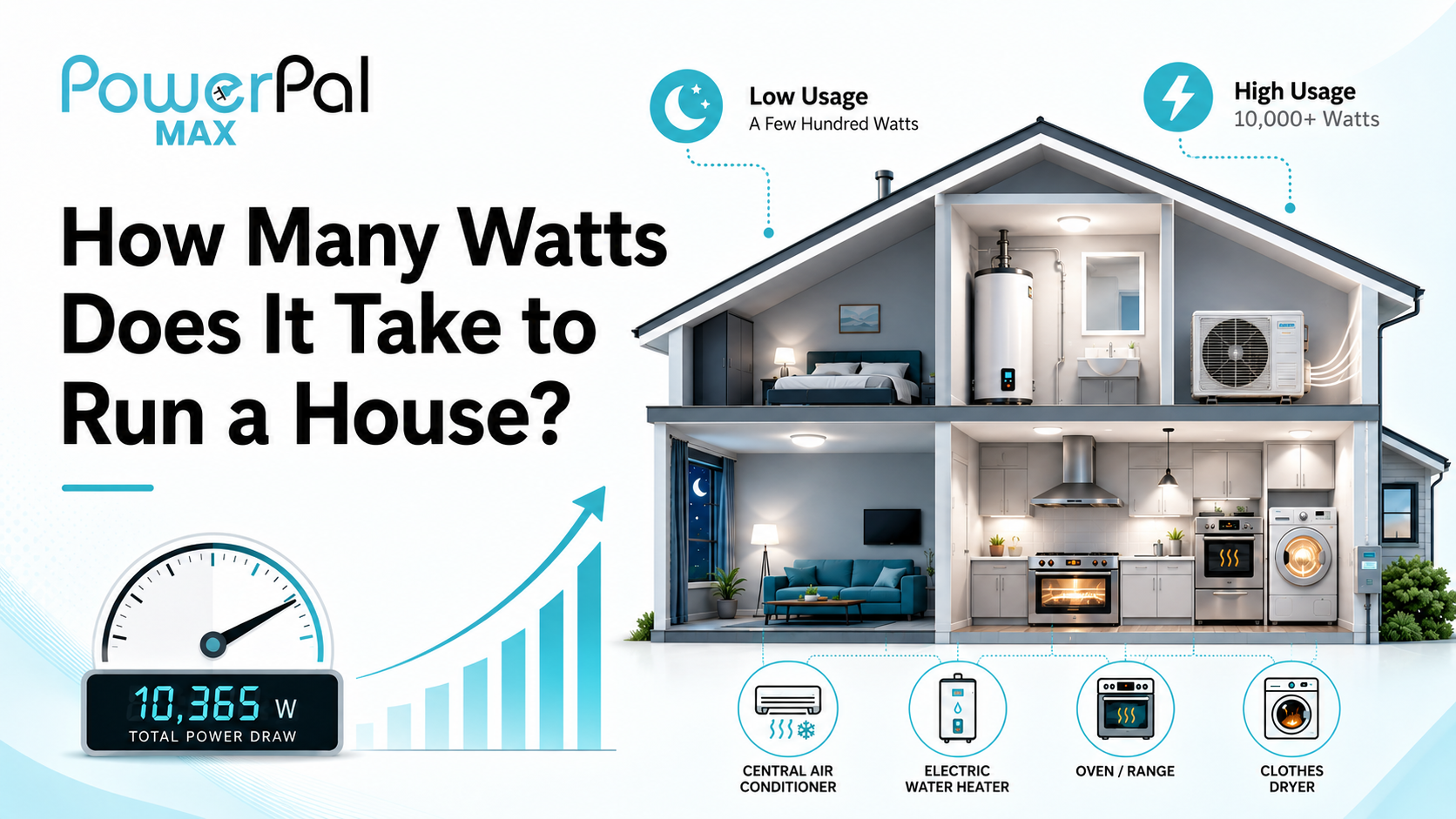
Your house does not run on one fixed number of watts. It may draw only a few hundred watts while you sleep, then jump to 10,000 watts or more when the air conditioner, water heater, oven, or clothes dryer switches on.
That difference matters…
Underestimate your power needs, and a generator, home battery, or solar inverter may struggle when you need it most.
Overestimate them, and you could spend more than necessary on capacity you rarely use.
So, how many watts does it take to run a house?
The answer depends on the size of your home, the appliances you use, your heating and cooling systems, and how many high-demand devices operate at the same time. You also need to distinguish between average electricity use, peak demand, and the brief surge of power some appliances require when starting.
This guide will help you calculate your home’s wattage, understand regional differences, and plan for backup power. You will also learn the important difference between monitoring electricity usage and receiving an alert when your property loses power.
How Many Watts Does a House Use?
Most homes have a continuous electrical load of several hundred to a few thousand watts. Demand can rise above 10,000 watts when electric heating, air conditioning, water heating, cooking equipment, clothes dryers, pumps, or EV chargers operate together.
Three measurements matter when calculating average home wattage:
Average load
Average load is the rate at which your home uses electricity over a period of time. It smooths out the daily changes caused by appliances switching on and off.
A home might have an average continuous load of 800 to 1,500 watts, for example, while still drawing several times that amount during periods of high demand.
Peak load
Peak load is the highest combined wattage required at one time.
Imagine that an electric oven, clothes dryer, water heater, and air conditioner are all running. Your peak demand during that period will be much higher than the average shown by your monthly electricity use.
Peak load is important when sizing a generator, solar inverter, battery system, or electrical service.
Starting or surge load
Appliances with motors and compressors may need extra power for a few seconds when they start.
Refrigerators, freezers, water pumps, and air conditioners are common examples. A backup power source must be able to handle this short increase as well as the normal running load.
Watts, Kilowatts, and Kilowatt-Hours
Watts and kilowatt-hours are often treated as interchangeable terms, but they measure different things.

You can calculate an appliance’s energy use with this formula:
Energy used in kWh = watts × hours of operation ÷ 1,000
For example, a 1,500-watt space heater operating for two hours uses:
1,500 × 2 ÷ 1,000 = 3 kWh

Your utility bill normally shows consumption in kilowatt-hours. That figure tells you how much electricity you used during the billing period, but it does not show the highest wattage your home required at one time.
Average Home Wattage by Country or Region
Household electricity use varies considerably among countries and among homes within the same country.
A useful way to estimate average continuous wattage is to divide annual electricity consumption by 8,760, the number of hours in a standard year.
For example:
10,000 kWh × 1,000 ÷ 8,760 = approximately 1,142 watts
That result is a mathematical average. It does not mean the house constantly uses 1,142 watts. Its real-time load may fall below that number overnight and rise far above it when large appliances are running.
Here is how regional differences can affect the calculation:

For perspective, U.S. residential customers purchased an average of about 865 kWh per month in 2024. That equals roughly 1,185 watts as a continuous mathematical average. Actual household demand still rises and falls throughout the day. U.S. Energy Information Administration
In England and Wales, median domestic electricity consumption was 2,500 kWh in 2024. That works out to approximately 285 watts as an annualized continuous average. The difference from the U.S. figure reflects factors such as property size, climate, cooling demand, and the use of gas for heating and hot water in many British homes. UK Government National Energy Efficiency Data Framework
One EU-wide number can also hide major differences among countries. Eurostat reports that space heating accounted for 62.5% of final household energy consumption in the EU in 2023. That includes fuels other than electricity, which is another reason total household energy use should not be confused with electrical wattage. Eurostat
These figures are useful benchmarks, but your meter, utility data, and appliance specifications provide a much better picture of your property.
What Uses the Most Watts in a House?
Small electronics contribute to household consumption, especially when they remain on for long periods. However, heating elements, motors, compressors, and chargers tend to create the largest loads.
The following ranges are general planning estimates. Actual wattage depends on the appliance’s model, size, efficiency, settings, and operating cycle.

Do not use these estimates as a substitute for a product’s electrical label or manual. Two appliances that perform the same job can have very different power requirements.
How to Calculate How Many Watts Your House Needs
You can estimate your home’s wattage in five steps.
1. Decide what you want to power
Start by defining the purpose of the calculation.
Are you estimating normal household demand, choosing a generator, planning a solar system, or determining which essentials a battery should support during an outage?
For an emergency backup plan, your list might include:
- Refrigerator and freezer
- Essential lights
- Heating system controls
- Medical equipment
- Sump or water pump
- Phone chargers
- Security equipment
- Selected office equipment
You may decide that an electric dryer, oven, or EV charger is not essential during an outage.
2. Find the running wattage
Check the appliance label, owner’s manual, or manufacturer’s website. If the label lists volts and amps but not watts, use this basic formula:
Watts = volts × amps
This calculation can provide a useful estimate, but it may not account for power factor or changing loads. Use the manufacturer’s stated wattage when available.
3. Check the starting wattage
Look for terms such as starting watts, surge watts, locked-rotor current, or startup current.
Equipment with motors or compressors may need more power when it starts than it does during normal operation. Ignoring that surge can cause an undersized generator or inverter to overload.
4. Add the loads that may run together
Do not simply total every electrical product in the building. Add the devices that are likely to operate at the same time.
Here is a simplified essentials-only example:

In this example, a 1,400-watt source would not provide enough capacity because it could fail when a compressor or pump starts.
Figures are illustrative. Check the ratings of your equipment before choosing a backup system.
5. Allow for operating headroom
A generator, inverter, or battery should not be selected solely from a perfectly balanced calculation. Future appliances, startup loads, changes in operating conditions, and manufacturer limits must be considered.
Follow the equipment manufacturer’s sizing guidance. Consult a qualified electrician or system designer for generator connections, electrical-panel work, and permanent backup installations.
Generator, Solar, and Battery Wattage Are Not the Same

“How many watts to run a house? ” can mean three different things when backup or renewable power is involved.
Generator capacity
A generator must support the running wattage of your chosen loads and any startup surge. An essentials-only generator can be much smaller than a system intended to operate the entire house.
Solar capacity
Solar panels are rated under specific test conditions. Real production changes with sunlight, temperature, panel direction, shading, season, and location.
A home that consumes 25 kWh per day does not simply need a 25 kW solar array. System planning must account for local solar production, inverter capacity, consumption timing, grid connection, and battery storage.
Battery capacity
A home battery has two relevant ratings:
- Power output in kW: How much load it can support at one time
- Energy capacity in kWh: How long it can support that load
A battery could have enough stored energy to run essential appliances overnight but still lack the power output needed to start a large air conditioner.
How to Measure What Your House Actually Uses
Calculated wattage tells you what your house could draw. Measured wattage tells you what it does draw, and the two are rarely the same. A plug-in monitor, a whole-home clamp monitor, or your utility’s own portal will each give you real numbers.
For which type suits which job, how to measure correctly, and how to turn the reading into a monthly cost, see how to monitor your home electricity usage.
Appliance energy labels
Energy labels let you compare annual consumption across similar products before you buy. In the United States, the FTC’s Energy Labeling Rule requires most major appliances to carry an EnergyGuide label showing estimated annual use in kilowatt-hours.
Treat it as a starting point, not an answer. That figure comes from a standardised lab test. What your appliance actually uses depends on how often you run it, how full it is, the temperature around it, and how old it has become. FTC EnergyGuide label.
Know When the Power Goes Out With Power Pal
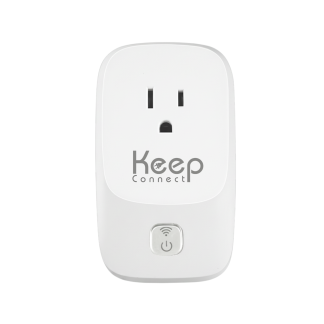
Understanding your average home wattage helps with energy planning. It does not tell you whether the power is on at an unattended property. PowerPal monitors power availability and sends an alert when power is lost, and again when it returns.
If an outage happens while you are away, an alert gives you a chance to check utility updates, contact someone nearby, protect temperature-sensitive items, or make other arrangements.
How to Reduce Home Wattage and Electricity Use
Lowering peak wattage and reducing total energy consumption are related, but they are not identical.
Reducing peak wattage means limiting the amount of equipment operating at the same time. Reducing energy use means consuming fewer kilowatt-hours over days, months, and years.
Practical steps include:
- Avoid running several high-demand appliances together.
- Switch off lights and electronics in empty rooms.
- Review heating and cooling settings.
- Maintain HVAC equipment and replace dirty filters.
- Use efficient LED lighting.
- Compare energy labels before buying appliances.
- Reduce unnecessary standby consumption.
- Review utility data for unusual changes.
- Use timers or schedules where they are safe and practical.
- Ask an electrician to investigate unexplained increases.
In Australia, heating and cooling contribute about 40% of the average household energy bill, according to the government’s Energy Rating program. That makes climate control a sensible place to look for savings. Australian Government Energy Rating
Frequently Asked Questions
How many watts does the average house use?
A home may draw several hundred watts during low-demand periods and several thousand watts when major appliances operate. Large all-electric homes can exceed 10,000 watts during peak use. The exact figure depends on the building, climate, appliances, and occupants.
Is 5,000 watts enough to run a house?
A 5,000-watt power source may run selected essentials, such as refrigeration, lights, electronics, and some pumps. It may not support electric heating, central air conditioning, water heating, cooking, or clothes drying at the same time. Startup wattage must also be included.
Is 10,000 watts enough to power a house?
Ten thousand watts may support a broader set of household loads, but it is not automatically enough for every home. Large air conditioners, electric heaters, water heaters, ovens, pumps, and EV chargers can create substantial demand.
How many watts does a house use per day?
Daily electricity consumption is measured in watt-hours or kilowatt-hours, not watts. Watts measure power at a particular moment. To find your daily use, check your utility account or subtract one day’s meter reading from the next.
How can I check how many watts my home is using?
You can use utility data, a compatible smart meter, a whole-home power usage monitor, plug-in appliance meters, or appliance labels. A qualified electrician can also assess household demand and electrical capacity.
Does Power Pal measure how many watts my house uses?
Based on the confirmed features of the standard model, Power Pal is a power-availability and outage-notification device. It should not be presented as a whole-home electricity usage monitor.
Will Power Pal tell me when electricity is restored?
Yes. Power Pal sends a notification when electrical power is lost and another notification when power is restored through its cloud-monitoring system.
Understand Your Power Use and Know When It Stops
Knowing how many watts to run a house helps you make better decisions about electricity use, generators, solar systems, and home batteries. Your home may use only a modest amount of power during quiet periods, then demand several thousand watts when heating, cooling, pumps, cooking appliances, or EV chargers operate together.
For an accurate estimate, list the equipment you want to power, check its running and starting wattage, and calculate which devices may operate at the same time. Use kilowatt-hour data to understand consumption over time, but do not confuse it with peak wattage.
Understanding your electricity use is only part of the picture. You also need to know when power becomes unavailable, especially when nobody is at the property.
Power Pal monitors electrical power availability and sends notifications when an outage occurs and when service returns. It gives homeowners, renters, families, schools, and businesses the information they need to respond sooner.
About the Author
Rona writes guides for Johnson Creative on router rebooting, internet reliability and home monitoring. Product details come from Johnson Creative's manuals and support articles. AI tools help with drafting, and every guide is reviewed and edited by Rona before publishing.