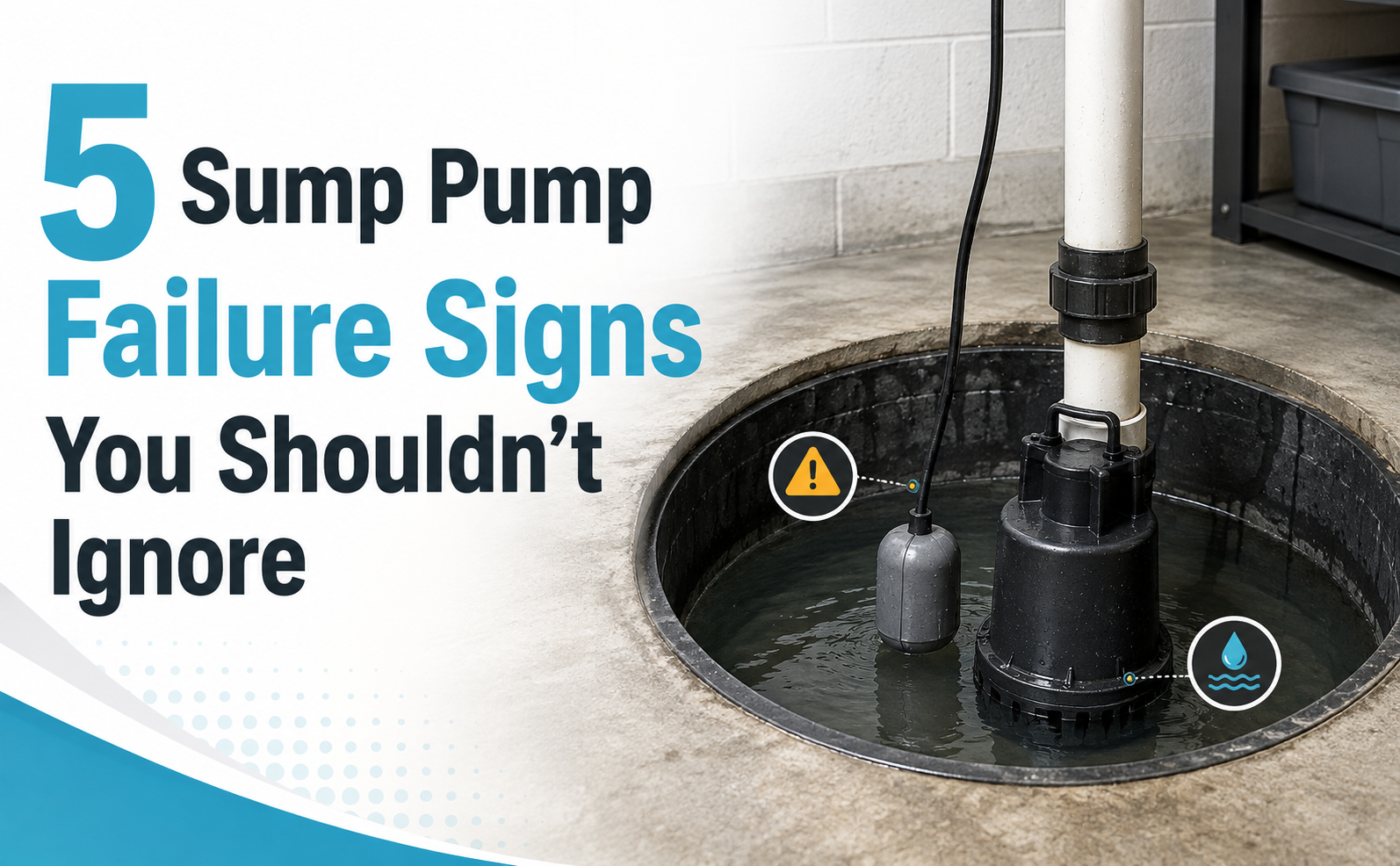
Sump pump failure signs often appear before the pump stops working completely. If your pump won’t start, works intermittently, runs without moving water, never shuts off, or overheats and trips the breaker, it needs attention before the next heavy storm.
A sump pump can sit unused for weeks, then face maximum demand the night a storm arrives. If the intake is clogged, the float is sticking, or the motor is worn, that storm is when a developing problem becomes water on the floor.
Complete failure often is not the first sign of trouble. Changes in sound, cycling frequency, runtime, water level, and heat can reveal sump pump problems before you need to act.
This guide covers five sump pump failure signs, what each usually means, how to test the pump safely, and when to call a professional.
Why Is My Sump Pump Not Working?
A sump pump that will not run usually comes down to four things: no power reaching it, a float switch that cannot move, a blockage in the intake or discharge, or a motor at the end of its life. Check them in that order, because the first two are the most common and the easiest to rule out.
Check power first. Confirm the pump is plugged in fully, the outlet has power, and the breaker or GFCI has not tripped. Many sump pumps use a piggyback plug where the float switch plugs into the wall and the pump plugs into the back of it. A loose connection there stops the pump while everything still looks connected.
Then check the float. The float must move freely through its full travel without touching the pit wall, the power cord, or the discharge pipe. A float pinned against any of those cannot signal the pump to start.
Then check for a blockage. Disconnect power first. A clogged intake screen or an obstructed impeller will stop water moving even when the motor runs.
Then consider the motor. A pump that hums without starting, trips the breaker, or smells hot has likely reached the end of its service life.
If water is rising while you work through this, skip to what to do right now.
What to Do If Your Sump Pump Is Not Working Right Now
If water is rising and the pump is not clearing it, work in this order.
- Check the breaker and the outlet. A tripped GFCI is the single most common cause and takes ten seconds to rule out.
- Lift the float by hand, as described above. If the pump runs, the float or its switch is the fault. Do not reach into a pit with standing water on the floor.
- Check the discharge outside. If the pump runs but nothing exits the discharge point, the line is blocked or, in cold weather, frozen. If water instead rushes back into the pit after the pump stops, that is a check valve problem, covered in our guide on why a sump pump runs constantly.
- Move water manually if you need to. A wet/dry vacuum or a utility pump buys you time. Do not use a household vacuum.
- Move anything valuable off the floor. Do this while you troubleshoot, not after.
- Cut power to the area if water reaches outlets or the panel. Do not wade into standing water near live electrical equipment.
If the pump is dead and water is still rising, stop troubleshooting and call someone.
Who to call if your sump pump stops during a storm
A plumber handles pump replacement and discharge line problems, and most areas have plumbers on emergency call.
A licensed electrician is the right call for repeated breaker trips, a burning smell, or damaged wiring, because the fault is upstream of the pump.
A water damage or restoration company handles extraction once water is already on the floor. They do not fix the pump.
Call your insurer early if water has reached finished space. Many policies require prompt notice, and sump pump failure coverage is often a separate endorsement, not part of a standard policy. Check what yours actually covers before you need it.
Can You Still Use Water If Your Sump Pump Is Not Working?
It depends on which pump you have, and the two are often confused.
A sump pump collects groundwater that would otherwise sit under the foundation. It is not connected to your household drains, so showering, flushing, and running the washing machine do not send water to it. In most homes you can keep using water normally while a sump pump is out of service.
A sewage ejector pump or grinder pump does handle wastewater from a basement bathroom or laundry below the main sewer line. If that pump is not working, using those fixtures can back up into the basement. Stop using them until it is repaired.
There are exceptions. Some older homes route a washing machine drain, a French drain, or a dehumidifier line into the sump pit. If yours does, heavy water use will add to a pit the pump cannot clear.
If you are not sure which pump you have, look at where it sits. A sump pump sits in an open pit collecting groundwater. A sewage ejector pump sits in a sealed basin with a vent pipe.
The 5 Sump Pump Failure Signs
|
Warning sign
|
What it may indicate
|
Suggested response
|
|---|---|---|
|
Grinding, rattling, or heavy vibration
|
Debris in the impeller,
worn bearings,
loose mounting or pipework
|
Inspect promptly
|
|
Cycling far more often, or never shutting off
|
Sticking float, failed check valve, undersized pump, high groundwater
|
Inspect promptly
|
|
Runs but moves little or no water
|
Clogged intake, jammed impeller, air lock, blocked or frozen discharge
|
Urgent
|
|
Excessive heat, burning smell, or repeated breaker trips
|
Overload, dry running, jammed motor, electrical fault
|
Stop using and call a professional if it is safe to do so
|
|
Starts intermittently, or only when the float is moved by hand
|
Failing float switch or electrical connection
|
Urgent
|
These responses are general guidance. Pump designs, duty cycles, and installation conditions vary, so follow your manufacturer’s instructions for your specific model.
Sign 1: New Noises or Excessive Vibration

A working sump pump generally produces a steady motor hum followed by water moving through the discharge pipe. New grinding, rattling, clanging, buzzing, or scraping may point to debris in the impeller, a worn motor bearing, a damaged or unbalanced impeller, loose pipework, or a check valve sticking or slamming.
Heavy vibration is a related signal. An impeller that has drawn in gravel or sediment can become damaged or unbalanced, which may place additional load on the motor.
First check whether a loose discharge pipe or pit cover is producing the sound. If the noise comes from inside the pump, disconnect power before inspecting. Never reach into the pit while the pump is connected to electricity.
Suggested response: Inspect promptly. Persistent grinding, scraping, or heavy vibration usually warrants professional inspection.
Sign 2: The Cycling Pattern Has Changed
Two variations matter: a pump switching on and off far more often than usual, and a pump that runs continuously without shutting off. Both place repeated or sustained load on the motor, which is why cycling changes matter for preventing pump burnout. Common causes include a sticking or obstructed float, a failed check valve letting discharged water return to the pit, an undersized pump, or a rising water table.
Heavy rainfall naturally increases pump activity, so more frequent running is not automatically a fault. What matters is a sustained change under otherwise ordinary conditions.
Suggested response: Inspect promptly and watch one full cycle. The float should move freely without contacting the pump, pit wall, power cord, or discharge pipe. Listen for water flowing back into the pit right after the pump stops, which may indicate a check-valve problem.
This sign has enough possible causes to warrant its own diagnosis. For the full walkthrough, see our guide on why your sump pump runs constantly.
Sign 3: The Sump Pump Runs but Is Not Pumping Water
A pump can switch on, sound normal, and still fail to protect the property. The water level in the pit shows what it is actually achieving.
Watch for water remaining high after a cycle, a pit emptying more slowly than before, weak or intermittent flow at the discharge outlet, water returning to the pit after the pump stops, or a pump running without visibly lowering the water.
Causes may include a clogged intake screen, an obstructed or damaged impeller, an air lock, a frozen or blocked discharge line, or a failed check valve. FEMA’s sump pump maintenance guidance identifies the inlet screen and check valve as components needing periodic cleaning and inspection, and recommends cleaning the inlet screen more than once a year. A pump running without moving water can also build heat quickly.
Suggested response: urgent. Check the outside discharge point for flow, and in cold weather, check accessible sections of the discharge line for freezing. If water is nearing the top of the pit, treat it as an active flooding risk.
Sign 4: Heat, Burning Odors, or Repeated Breaker Trips
Some issues appear outside the pit: a housing that feels unusually hot, a burning or electrical smell, a breaker or GFCI outlet that trips repeatedly, visible corrosion on electrical components, or a damaged power cord. Excessive heat may result from a jammed impeller, dry running, an overload, a restricted discharge, or a motor nearing the end of its service life.
Do not repeatedly reset a breaker without identifying the cause. Repeated tripping may signal an overload, short circuit, jammed motor, or failing pump. Do not use an extension cord or modify the pump’s wiring as a temporary fix.
Suggested response: Stop using the pump and call a professional if you can safely switch it off. Have suspected electrical faults evaluated by a qualified electrician or pump technician.
Sign 5: The Sump Pump Starts Unreliably or Will Not Turn On
This one is easy to dismiss because the pump eventually runs. Watch for a pump that starts only sometimes, that needs the float lifted or nudged by hand first, or that stays silent while water is clearly present in the pit.
Intermittent starting commonly points to a float switch on its way out, a float obstructed by the pit wall or power cord, or a loose electrical connection. A switch that works most of the time will keep working most of the time, right up until the night it does not.
Suggested response: urgent. Intermittent operation is not a minor fault in equipment whose purpose is to work unattended during a storm.
How to Know If Your Sump Pump Is Working

Follow the instructions for your specific pump model. Do not reach into the pit if there is standing water on the floor, if wiring appears damaged, or if you are uncertain. Water and electricity are a dangerous combination.
The water test. Slowly pour clean water into the pit until the float rises. The pump should activate, lower the water, and shut off automatically. Confirm water reaches the intended discharge point away from the building.
That single test checks four things: whether the pump starts, whether it moves water, whether it stops on its own, and whether it sounds the way it used to. If water rises above the pump without it activating, possible causes include an obstructed float, a tripped outlet or breaker, or a pump that needs replacement.
Test periodically and before expected heavy rain or snowmelt. No monitoring device removes the need to inspect the pit, float, check valve, discharge line, power supply, and backup system.
Why These Signs Are Easy to Miss
Grinding noise. Cycling patterns. Slow drainage. A float that needs nudging. Each requires someone to be near the pit when it happens. A pump may run longer on each cycle, draw more current, and cycle more often over weeks with nobody there to notice. The behavior is measurable. It is simply not audible from another floor, and that gap widens for a vacation home, a rental property, or any building left unoccupied for stretches at a time.

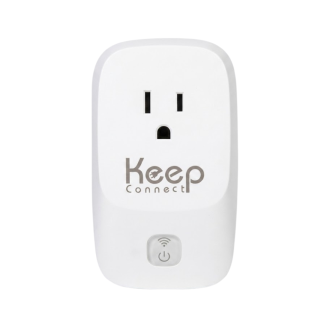
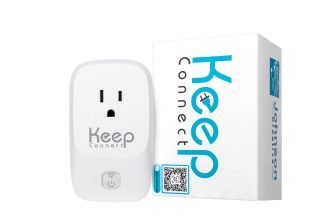
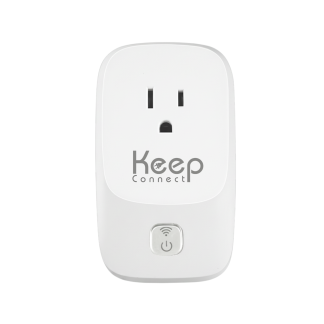
Pump Pal by Keep Connect is a plug-in monitor that sits between the pump and a standard outlet and analyzes the pump’s electrical load and operating behavior. It does not require a float switch, a sensor in the pit, drilling, or new wiring.
During setup, it learns what normal looks like for the connected pump. The Pump Pal setup documentation describes a calibration period covering the first five valid pump runs, during which it records typical current draw and run time.
After calibration, Pump Pal analyzes electrical-load and runtime patterns associated with several common problems, including dry running or air lock, overload or blockage, runs longer than the learned normal, runs continuing past a maximum allowed runtime, and cycling that restarts too frequently.
When it detects abnormal operation, it sends an SMS or email alert. Activity logs and runtime history show changes in cycle frequency, run duration, and power behavior that are otherwise hard to observe.
How this differs from a high-water alarm. A conventional high-water sump pump alarm generally responds once water reaches a sensor at a set level. Pump Pal monitors the pump’s own behavior instead. Depending on the property, an owner may want both. For a fuller comparison and the installation walkthrough, see our guide on setting up a sump pump monitoring system.
What it does not do. Pump Pal monitors and alerts. It does not repair a failing pump, replace one at the end of its life, or keep a pump running during an outage. It depends on available electricity and network connectivity, so it belongs inside a broader plan that may include a battery-powered or water-powered backup pump, a high-water alarm, and backup connectivity.
Compatibility. Pump Pal is listed for standard three-prong 120V pumps up to 1 HP, covering many sump, well, utility, sewage and ejector, irrigation, and pool pumps. Buyers outside the United States should first verify plug type, supply voltage, pump rating, and local electrical requirements. A travel adapter does not make a 120V device suitable for a different supply voltage.
Repair, Replace, or Monitor?
Age is worth weighing, but it’s not the only factor. Installation conditions, workload, build quality, maintenance, and water debris all affect longevity.
Two authoritative sources give different figures. FEMA recommends assessing the pump annually and replacing it if it is more than 10 years old, if deep puddles form around the home when it rains, if you never hear it running, or if you hear it powering on and off during rain. InterNACHI’s Estimated Life Expectancy Chart for Homes lists 7 years as the estimated service life, noting its figures are guidelines rather than guarantees. Treat the range between them as a prompt to inspect more carefully, not as an expiry date.
Repair may be reasonable when the pump is relatively new, the fault is a single identifiable component such as a float switch or check valve, and the motor sounds and performs normally.
Replacement is worth considering when the motor itself is the problem, when repair cost approaches the price of a new pump, when several signs appear at once, or when the pump is past the age range above.
Rust on the body, corrosion at the electrical connections, and heavy sediment in the pit are all worth noting during an inspection. Monitoring complements this decision rather than replacing it.
Frequently Asked Questions
Why won’t my sump pump turn on?
A sump pump that will not turn on usually has a power problem or a float problem. Check that the outlet has power and the breaker or GFCI has not tripped, then confirm the float moves freely without catching on the pit wall, cord, or discharge pipe. If the pump runs when the float is lifted by hand, the float switch is failing.
What are the most common sump pump failure signs?
Common sump pump failure signs include unusual noises, heavy vibration, changing cycle frequency, continuous running, slow water removal, intermittent starting, excessive heat, burning odors, and repeated breaker trips.
How do I test whether my sump pump is working?
Slowly pour clean water into the pit until the float rises. The pump should activate, lower the water, and shut off automatically. Confirm that water exits through the discharge line and does not flow straight back into the pit.
Follow the pump manufacturer’s instructions. Avoid the pit if there is standing water, damaged wiring, or another electrical hazard.
Why is my sump pump running but not removing water?
Possible causes include a clogged intake or impeller, blocked or frozen discharge line, damaged check valve, or air lock. Disconnect power before inspecting accessible components, and call a qualified professional if the cause is not obvious.
What should I do if my sump pump stops working during a storm?
Check the breaker or GFCI first, then lift the float by hand to see whether the pump runs. Check the outside discharge point for flow. Move water with a wet/dry vacuum or utility pump if the level is rising, move valuables off the floor, and call a plumber. Do not wade into standing water near live electrical equipment.
Can you shower if your sump pump is not working?
Usually yes. A sump pump collects groundwater and is not connected to household drains, so normal water use does not add to it.
A sewage ejector pump is different. It handles wastewater from basement fixtures, and using those fixtures while it is out of service can cause a backup. Check which pump you have before using water.
Why does my sump pump hum but not turn on?
A sump pump that hums without starting usually has a seized impeller, a jammed float, or a failing motor component. Debris locking the impeller is the most common cause. Disconnect power before inspecting. Repeated humming with no movement, especially with heat or a burning smell, means the pump should be checked by a professional rather than reset again.
How long does a sump pump last?
Published guidance differs. FEMA suggests considering replacement when a pump is more than 10 years old, while InterNACHI lists seven years as an estimated service life. Actual lifespan varies with workload, installation, build quality, maintenance, and operating conditions.
Age should be treated as a reason for closer inspection, not as an automatic expiration date.
Will Pump Pal keep my sump pump running during a power outage?
No. Pump Pal is a monitoring and alerting device, not a battery backup or generator. A complete protection plan should include appropriate backup pumping and power arrangements.
Act on the Warning, Not the Flood
Sump pump failure signs usually appear before the pump stops. Noise, cycling changes, slow drainage, heat, and unreliable starting all provide some notice.
Test the pump periodically and before heavy weather, note its age, and treat burning odors and repeated breaker trips as immediate issues rather than things for next weekend. Where a pump sits in a building nobody visits often, consider closing the gap between when a problem starts and when you find out about it.
Monitor abnormal pump activity before a hidden problem becomes an emergency. Explore Pump Pal by Keep Connect