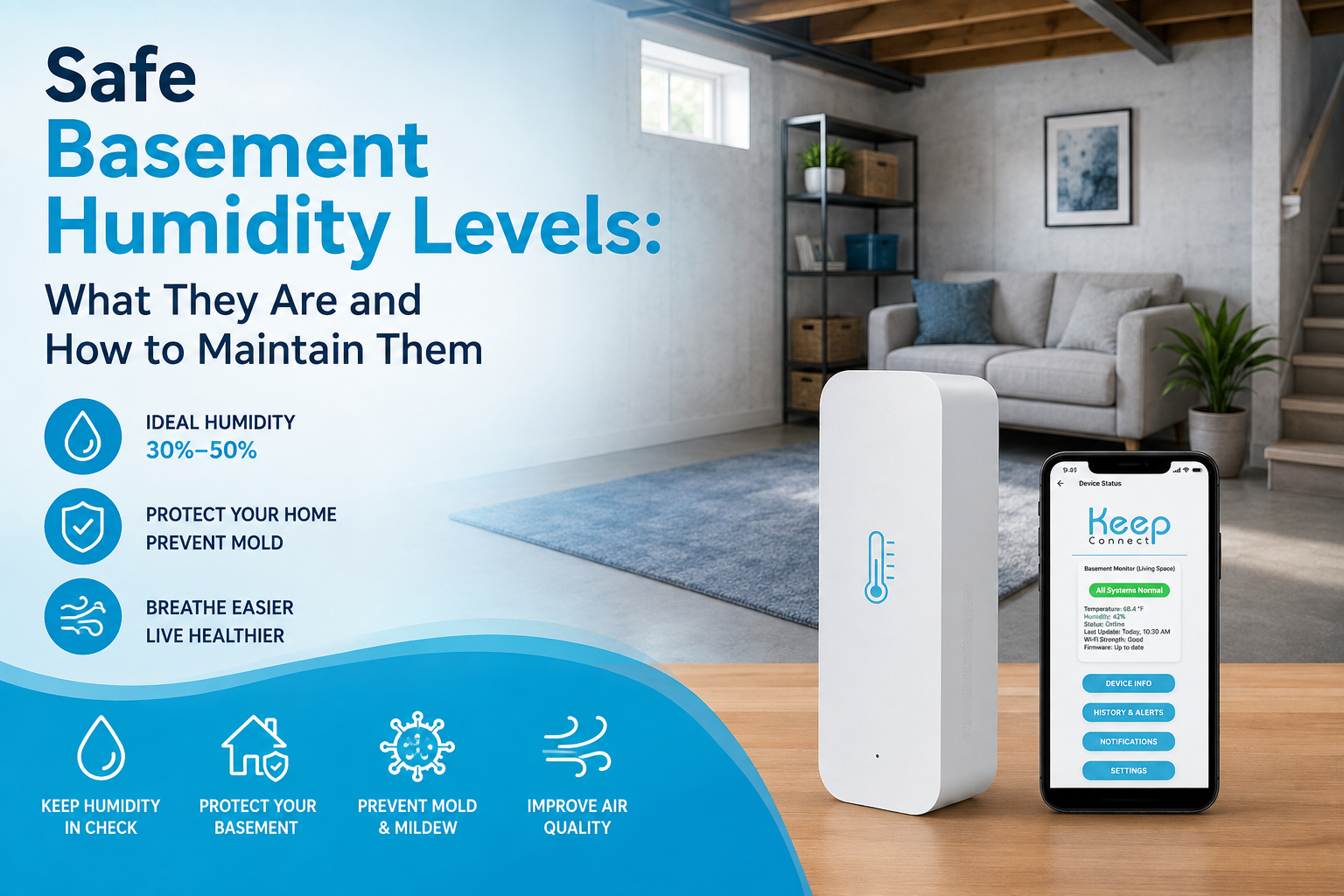
Mold does not need a flood to start growing in your basement. It only needs moisture, poor airflow, and humidity that stays too high for too long. Most homeowners find out too late — because they never measured.
In general , the perfect basement humidity level is between 30-50 % relative humidity. EPA suggests that indoor humidity be kept below 60% and, if possible, between 30% and 50%. The EPA also recommends drying wet or damp materials within 24 to 48 hours to prevent mold growth.
What Is the Safe Humidity Level for a Basement?
The ideal range for safe basement humidity is generally 30% to 50% relative humidity. If basement humidity consistently rises above 60%, moisture problems are more likely to develop, including condensation, musty odors, mold potential, rust and damage to goods stored. Don’t guess, use a basement humidity monitor to track levels.
Here is a simple humidity scale:
| Basement Humidity Level | What It Means | What to Do |
|---|
| Below 30% | Too dry for many homes | Add moisture only if needed |
| 30% to 50% | Ideal basement humidity range | Maintain and monitor |
| 50% to 60% | Slightly elevated | Watch trends and improve airflow |
| Above 60% | Too humid | Run a dehumidifier and check moisture sources |
| 70% or higher | High-risk moisture level | Act quickly to prevent mold, musty odors, and damage |
Knowing the number is important because moisture in a basement can change quickly. A basement may feel fine in the morning, then climb to over 60% humidity after a storm, a hot afternoon, or a few days of damp weather.
So the better question is not just, “What should the basement humidity be?” It’s also, “How long is my basement going to be above safe range?”
Why Basement Humidity Spikes in Summer
Basements tend to be more humid in summer because they are cooler than the air outside.
Warm air can hold more water vapor. When that warm, humid outside air enters the cooler basement, it can deposit moisture on walls, floors, pipes and stored items. That’s why a basement can feel damp even if there’s no standing water.
Warm outdoor air hits cooler basement walls and condenses
Condensation is what happens when warm, moist air hits a cooler surface.
Down in a basement, those cooler surfaces could be:
- Walls of concrete
- Basement floors
- Piping
- Ducting
- Window frames
- Furniture in storage boxes
- Appliance
- metal implements
Which is why basement humidity in the summer can be worse than basement humidity in the winter. It might be hot and humid outside, but the basement stays naturally cooler.
If these two conditions are met, moisture buildup is possible.
That moisture may not seem dramatic at first. you might smell a musty odour, damp cardboard, rust on tools, or feel a clammy dampness in the air. But those early signs are red flags.
Summer rain increases groundwater pressure
Heavy summer rain can also increase basement humidity.
As the surrounding soil becomes saturated, water pressure against basement walls and floors increases. Moisture can enter the basement even if there’s no visible water. It can seep in through small cracks, porous concrete, window wells, or gaps around utility penetrations.
You might see:
- Wet spots on walls
- White mineral deposits
- Musty smell after rain
- Post-rain higher humidity readings
- Damp at the floor/wall junctions
- Condensation on windows, pipes
This is where basement moisture connects to broader water protection. If you see more humidity in the basement after storms, you may also want to check gutters, downspouts, grading, window wells, and the sump pump operation.
For more ways to protect against storms, read How to Prevent Basement Flooding During Summer Storms or take a look at the Water Leak Detection Guide.
AC may not dehumidify the basement effectively
Air conditioning cools the air and removes some humidity but might not be sufficient to control basement humidity.
This is especially true if the basement has poor airflow, closed doors, little return air movement, or a weak connection to the HVAC system. The upstairs may be comfortable and the basement damp.
An AC may also not remove enough moisture if it short cycles, is oversized or doesn’t run long enough. If the system shuts off quickly after cooling, it may not be removing enough humidity from the air.
That’s why basements generally require their own monitoring and sometimes a dedicated dehumidifier.
What Happens When Basement Humidity Is Too High
Basements don’t always warn you right away when there’s too much moisture.
You might not see water on the floor. You may not see mold right away. But high humidity can still ruin the space over time.
Mold growth (24-48 hours at above 60% — EPA guidance with citation)
The EPA recommends that indoor relative humidity levels stay below 60 percent, ideally between 30 percent and 50 percent. EPA guidance also advises drying wet or damp areas and items within 24 to 48 hours to help prevent mold growth.
This means two things for homeowners with basements:
First, do not ignore humidity over 60 percent. Second, all damp materials such as carpet, cardboard, wood, drywall, insulation, furniture, or stored items should be dried quickly.
A major flood isn’t necessary for mold. Persistent dampness is enough.
Musty smell and air quality degradation
One of the first signs that your basement has moisture problems is a musty smell.
The odor is frequently the result of damp materials, microbial growth, or stale air. Even without the appearance of mold, the odor indicates the basement environment is not dry and fresh.
Stairways, ductwork, cracks, and air leaks can also allow musty basement air to enter the rest of the home. That’s one reason why basement humidity should not be viewed as a basement-only issue.
If you smell a musty odor in the basement, check the humidity. Don’t trust your nose alone.
Wood rot in framing, subfloor, and stored furniture
High humidity can damage wood over time.
Moisture can be absorbed by framing, subflooring, wooden shelves, cabinets, and stored furniture. Wetness in the basement can cause wood to swell, warp, soften or decay.
Warning signs include:
- Swollen trim
- Warped shelving
- Softwood near floors
- Damp furniture legs
- Musty wooden objects to store
- Stained framing
- Peeling paint or finish
Finished basements are particularly susceptible as moisture can lurk behind walls, under flooring or inside cabinets.
Rust and corrosion on tools and appliances
Basement moisture can also destroy metal.
Tools, appliances, shelving, HVAC parts, bikes, exercise gear, stored hardware could rust faster in a humid basement.
Look for:
- Tools with rust
- Metal shelf rust
- Appliance rust spots
- Damp concrete under metal objects
- Odor of mold around storage areas
- Condensation on pipe or equipment
If you notice metal items rusting in your basement, it’s likely too humid for long-term storage.
How to Measure Basement Humidity
You can’t improve what you don’t measure.
Basement humidity varies with season, weather, time of day, HVAC usage and drainage conditions. A one time reading helps but monitoring over time tells you the pattern.
Simple hygrometers vs WiFi humidity monitors
A simple hygrometer is a cheap way to check the humidity in your basement.
It can display the current temperature and relative humidity. It’s a handy little thing if you just want a quick read.
But a simple hygrometer has its limits:
- You have to physically check it.
- It may not alarm you.
- It may not be trendy.
- It might not tell you what happened all night.
- But it may not help you while you are away.
Wifi humidity monitor is better if you want remote visibility and alerts.
A WiFi monitor can help answer:
- Was it more humid after rain?
- Is the basement above 60% all night?
- Will the dehumidifier keep up?
- Does humidity make summer bad?
- Post drainage work, are levels rising?
- Will the basement be safe when I am traveling?
To learn more about monitoring indoors, see the Temperature and Humidity Guide.
How Climate Pal monitors basement humidity remotely with alerts
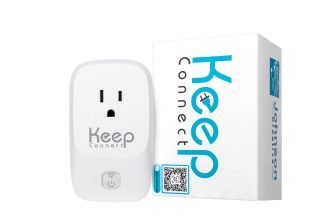
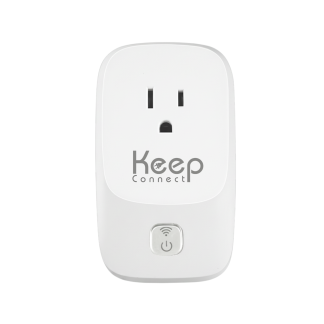
Climate Pal by Keep Connect keeps track of temperature and humidity in the area where you put it, including in a basement.
It can be used to monitor basement humidity remotely and set up alert thresholds when it goes above your safe range. That gives you a heads-up before the humidity becomes a long-term moisture problem.
Climate Pal is good for basements because the room could be out of sight for days at a time. You can’t go downstairs until the humidity has been high enough to smell or to store damp things or to risk mold.
Place Climate Pal in an open area of your basement and allow air to circulate around it. Do not place it up against a concrete wall, next to a dehumidifier outlet, near a window, or in a concealed corner where readings may not be representative of the entire room.
You can also check out the Climate Pal product page for more product details.
How to Lower Basement Humidity
Once you know your basement is too humid, the next step is to reduce it.
The right fix depends on what is causing the problem. Some basements require a dehumidifier. Others require better drainage, sealing, air circulation, or a combination of all four.
Run a basement dehumidifier (size guide)
A dehumidifier is often the fastest way to bring basement humidity down.
Choose the size based on the basement area and how damp the space is.
| Basement Condition | Suggested Starting Point |
| Small basement, slightly humid | Smaller capacity dehumidifier |
| Medium basement, regular summer dampness | Mid-size dehumidifier |
| Large basement or very damp space | Larger capacity dehumidifier |
| Basement with visible water issues | Fix water source first, then dehumidify |
| Finished basement | Use enough capacity to protect drywall, flooring, and furniture |
Typically, if the humidity level in your basement is still over 60%, it’s usually worth running a dehumidifier.
Put it where air can get at it. Periodically empty the tank or connect a drain hose if the unit is capable of continuous draining. Clean the filter as recommended by the manufacturer
A dehumidifier can help manage the moisture in the air, but not as a bandage for active leaks or drainage failure.
Improve drainage around the foundation
If the humidity jumps from the rain, check outside.
Usually, basement moisture starts with water pooling at the foundation. Drainage improvements can reduce the amount of moisture reaching basement walls and floors.
Check:
- Gutter
- Downspouts (gutter pipes)
- Downspout extensions
- Grading of soil
- Window Well
- Sump Pump Drainage
- Low points by the foundation.
- driveway/walkway slope
- Pooling stormwater
Downspouts should direct water away from the house. Soil should slope away from the foundation whenever possible. Window wells are meant to drain, not to hold water.
Lowering the water pressure outside can make basement humidity easier to control.
Seal basement walls with waterproofing paint
For interior basement walls, you can try applying a waterproofing paint or masonry sealer to reduce minor dampness.
It is most useful for minor moisture problems, not major water pressure, active leaks, or structural cracks.
Before any coating:
- Wipe the wall
- Remove loose paint.
- Check for live leaks.
- Repair cracks as necessary
- Follow product instructions.
- Ensure that the surface is suitable
If water pressure is trying to push through the wall, then paint alone may fail. If so, exterior drainage, crack repair or professional waterproofing may be required.
Increase air circulation with fans or HVAC adjustment
Basement humidity is worse when the air is still.
Fans can help to push air through the space. If the basement is poorly connected to the rest of the house, HVAC adjustments might help too.
Try:
- Interior doors open where needed
- Using a fan to assist with circulation.
- Ensuring vents aren’t blocked
- Check return airflow
- Avoiding storage piles along the walls
- Leave space around furniture and boxes
- Items from wet floors
Air movement will not dry out moisture unless there is somewhere for the moisture to go. Dehumidification, drainage improvements or HVAC support fans
How to Monitor Basement Humidity Year-Round
Basement humidity is a seasonal problem, but monitoring for it should not be.
A basement can be dry in winter, damp in spring, humid in summer, and susceptible in storms. Year-round monitoring allows you to identify trends rather than react when problems exist.
Set alert thresholds at 55% and 65%
A simple alert plan does work.
Set an early warning at about 55% and one alert. That means humidity is on the rise and may need some attention.
Action point: put a stronger alert at 65%. At this level, operate the dehumidifier, check for damp materials, improve the airflow, and check the drainage.
This gives you a good practical starting point you can adjust with your home.
| Alert Level | Meaning | Action |
| 55% RH | Watch zone | Check trend, airflow, and dehumidifier settings |
| 60% RH | Too humid | Start reducing humidity |
| 65% RH | Action zone | Run dehumidifier and inspect moisture sources |
| 70%+ RH | High-risk zone | Act quickly and check for damp materials |
The peak number is only part of the key. That’s how long the basement remains high.
How to read trends from Climate Pal data over weeks
One reading of the humidity tells you the moment. The story is in the trend data.
Look for patterns such as:
- Humidity jumps after rain
- Humidity increases overnight
- Dehumidifier not able to keep humidity below 60%
- Downspout repairs reduce basement humidity
- Open windows increase humidity
- One area is still more damp than the rest
- Long hot spells increase humidity
- As temperature goes up, so does humidity
Over several weeks, these patterns guide you to know whether the problem is weather, drainage, airflow, HVAC behaviour, or a failing dehumidifier.
This is where Climate Pal comes in. Instead of guessing, you can monitor basement humidity over time and get alerts when readings go above your threshold.
Keep Connect’s Climate Pal gives you real-time readings of the humidity level in your basement — and alerts you the instant it goes above your set threshold, so you can take action before mold takes hold. Check it out at johnson-creative.com
Frequently Asked Questions
What causes high humidity in basement?
Excess humidity in the basement is usually the result of warm outdoor air entering a cooler basement, lack of air circulation, seepage through the foundation, summer rain, damp crawl spaces, blocked drainage, or an AC system that does not dehumidify the basement effectively.
Is 70% humidity bad in basement?
Yes. A basement is too humid at 70%, and you want to bring that down. At this level, musty odors, condensation, mildew, rust, and damage to stored goods are all more likely. Use a dehumidifier and find the sources of moisture.
What dehumidifier size for basement?
The correct size dehumidifier depends on the size of the basement and the moisture level. A small, slightly damp basement might need only a smaller unit, while a larger or very damp basement will generally require a dehumidifier with more capacity. If humidity stays above 60%, pick more capacity or find the moisture source.
What should basement humidity be?
Basement humidity should usually stay between 30% and 50% relative humidity. Try to keep it below 60% at all times. If it regularly rises above 60%, use a dehumidifier, improve drainage, increase airflow, and monitor the basement more closely.
Do I need a basement humidity monitor?
Yes, a basement humidity monitor is useful, as humidity can rise without any water showing up. A monitor will tell you when levels are safe, when they cross your threshold, and whether your dehumidifier or drainage improvements are working.
Should I run a basement dehumidifier all summer?
If humidity stays above 50% to 60%, you may need to run a basement dehumidifier through much of the summer. A humidity monitor will tell you. If the basement stays in the safe range without the dehumidifier, you may not need to run it all the time.