How many watts does an air conditioner use? A typical 3- to 4-ton central air conditioner draws about 3,000 to 5,000 watts while running. A window unit usually uses 500 to 1,500 watts, and a portable AC about 1,000 to 1,750. Your cost depends on those watts, the hours the compressor runs and your rate.
Your air conditioner is often the biggest driver of your summer electric bill. Yet most homeowners do not know what it costs per day until the bill arrives. So how many watts does an air conditioner use, and what does that mean for your bill?
The answer depends on the type of AC, its size and efficiency, and how many hours the compressor runs. This guide covers central, window, portable and mini-split units, shows how to turn watts into kWh and dollars, and explains why your bill may be higher than it should be.
Table of Content
How Many Watts Does a Central Air Conditioner Use?
A typical 3- to 4-ton central air conditioner draws about 3,000 to 5,000 watts while the compressor is running. Smaller and more efficient systems draw less. Larger and older ones draw more.
Central AC is sized in tons. One ton of cooling equals 12,000 BTU per hour. Efficiency is rated by EER, which the U.S. Department of Energy defines as cooling capacity in BTU per hour divided by power input in watts. So you can estimate running watts with one line of math: watts = BTU per hour ÷ EER.
| AC size | Cooling capacity | Estimated running watts (EER 12 to 8) | kWh per 8 compressor-on hours |
|---|---|---|---|
| 1 ton | 12,000 BTU | 1,000 to 1,500 | 8 to 12 |
| 2 tons | 24,000 BTU | 2,000 to 3,000 | 16 to 24 |
| 3 tons | 36,000 BTU | 3,000 to 4,500 | 24 to 36 |
| 4 tons | 48,000 BTU | 4,000 to 6,000 | 32 to 48 |
| 5 tons | 60,000 BTU | 5,000 to 7,500 | 40 to 60 |
The chart uses EER 12 for the low end and EER 8 for the high end. It is a general planning estimate, not a measurement of a specific model. Your AC’s nameplate or spec sheet lists its actual electrical rating.
An AC does not draw full power all day, though. It cycles on and off, and some systems change speed, to hold the temperature you set. So your cost depends on two things together: how many watts it draws and how many hours the compressor actually runs. That is why two homes with the same size AC can have very different summer bills.
How Many Watts Does a Window or Portable AC Use?
A window air conditioner usually uses about 500 to 1,500 watts, depending on its size. A portable AC typically uses about 1,000 to 1,750 watts. Both use far less than a central system because they cool one room, not the whole house.
| AC type | Typical running watts | Best for |
|---|---|---|
| Window AC, about 5,000 to 8,000 BTU | About 500 to 800 | A bedroom or small room |
| Window AC, about 10,000 to 15,000 BTU | About 1,000 to 1,500 | A larger room or studio |
| Portable AC, about 8,000 to 14,000 BTU | About 1,000 to 1,750 | Temporary or single-room cooling |
| Mini-split | Varies with capacity and compressor speed. Check the spec sheet | One or more zones |
| Central AC, 3 to 4 tons | About 3,000 to 5,000 | Whole-home cooling |

Window and portable units plug into a standard outlet. That makes them easier to measure (see the safety note in the measuring section below). It also means a tripped breaker or a power outage can switch them off without anyone noticing.
How Much Electricity Does a Mini-Split Use?
A ductless mini-split has an outdoor unit and one or more indoor heads mounted on a wall or ceiling, each cooling its own zone, as ENERGY STAR describes. Many mini-splits use an inverter compressor that changes speed to match the cooling load instead of only switching fully on and off.
Because the speed changes, a mini-split does not have one fixed wattage, and its maximum or rated input is not its average draw. Its use depends on its capacity, efficiency rating, how many zones run, your climate and how much cooling the rooms need. A mini-split is not automatically cheaper to run than every other system. To estimate yours, use the rated power on the spec sheet, or better, measure its kWh over several days.
How Many Amps Does an Air Conditioner Use?
An air conditioner’s current draw depends on its voltage, compressor, fan motors, efficiency and operating conditions. Dividing watts by volts gives only a rough estimate because air conditioners are motor-driven loads, and their power factor and startup current also matter.
Check the unit’s nameplate and installation manual for its rated current and electrical requirements. Central systems may list a minimum circuit ampacity and a maximum fuse or breaker size. Use those manufacturer values, not an online wattage estimate, for any wiring or circuit decision. Have a qualified electrician handle permanent wiring or circuit changes.
How to Calculate What Your AC Costs Per Month
Watts, kilowatts and kilowatt-hours
Watts measure how much power the AC draws at a moment. A kilowatt is 1,000 watts. A kilowatt-hour (kWh) is the energy used when 1,000 watts run for one hour, and it is the unit on your electric bill.
You need four numbers:
- The AC’s power draw while actively cooling
- Total compressor-on hours per day at about that power
- Days in the billing period
- Your electricity rate per kWh (on your bill)
Then use this formula:
Monthly cost = (watts × compressor-on hours per day × days) ÷ 1,000 × rate per kWh
The U.S. Department of Energy uses the same math: energy in kWh equals kilowatts times hours, and cost equals the rate times kWh.
This formula works best for equipment with a fairly steady power draw. Six hours with the thermostat set to cool does not necessarily mean six compressor-on hours. Variable-speed and inverter systems also change their power draw while they run. For those systems, use measured cumulative kWh whenever possible.
Example. Say your central AC draws 4,000 watts and the compressor runs 6 hours a day for 30 days. You pay $0.18 per kWh, close to the U.S. average residential price of 18.31 cents per kWh in July 2026.
(4,000 × 6 × 30) ÷ 1,000 = 720 kWh. Then 720 × $0.18 = $129.60 a month.
| Running watts | Compressor-on hours per day at stated wattage | kWh per month | Estimated monthly cost |
|---|---|---|---|
| 1,500 | 6 | 270 | $48.60 |
| 3,000 | 6 | 540 | $97.20 |
| 4,000 | 8 | 960 | $172.80 |
| 5,000 | 8 | 1,200 | $216.00 |
| 6,000 | 10 | 1,800 | $324.00 |
These examples assume the unit draws the listed wattage for every compressor-on hour. They are calculation examples, not predictions for a particular home.
Your rate may be higher or lower than the national average. Use the rate printed on your bill.
Central AC or Window Units: Which Costs Less to Run?
A central AC usually draws more total power than one window unit because it serves a larger area. Total cost still depends on efficiency, runtime, climate and how many rooms are cooled. However, lower wattage does not always mean a lower bill. Three or four window units running all day can use as much electricity as one central system.
Which one costs less depends on how you cool your home:
- Cooling one bedroom at night: a window AC is often cheaper.
- Cooling the whole house evenly: a modern central AC with sealed ducts may make more sense.
- Cooling only the rooms you use: window units or a mini-split can save money, depending on the models and your home.
- Cooling a poorly insulated house: any system can use more power than expected.
Why Your AC Bill Is Higher Than Expected
If your bill jumps but the weather hasn’t changed much, your AC may be working harder than it should, though rate changes and other household loads can also raise the bill. If your AC checks out, see these other reasons your electric bill is so high.
Five common causes on the AC side:
- Wrong size. An oversized unit short cycles and leaves the air clammy. An undersized one runs almost nonstop.
- Dirty air filter. Restricted airflow makes the system run longer. Check the filter monthly during cooling season.
- Low refrigerant from a leak. The system runs longer and cools less. A qualified HVAC technician should find and repair the leak before recharging it.
- Leaky ducts. ENERGY STAR estimates that about 20 to 30 percent of the air moving through a typical duct system is lost to leaks, holes and poorly connected ducts.
- Aging equipment. Worn parts and dirty coils raise energy use, especially in systems more than 10 to 15 years old.
To tell whether your AC is running more than it should, see our guide to the signs your AC is running too much.
How to Measure Your AC's Actual Electricity Use
Estimates are a starting point. To know what your AC really uses, measure it:
- Window and portable units: a plug-in electricity usage monitor can show watts and total kWh. Use only a listed monitor rated for the AC’s voltage, amperage and motor or compressor load. Follow the AC manufacturer’s instructions, and do not use an undersized smart plug, adapter or extension cord.
- Central AC and mini-splits: they are hardwired, so a plug-in monitor cannot reach them. Measuring them takes a circuit-level or whole-home energy monitor installed at the panel by a licensed electrician.
Once you know your normal daily kWh, compare days with similar weather. A rise with no change in weather or thermostat settings suggests the system is working harder. For a whole-home approach, see how to monitor your home electricity usage.
How to Lower Your AC Electricity Cost
You do not have to sit in a hot house to lower your AC bill. Start with the changes that stop wasted cooling.
| Action | Why it helps |
|---|---|
| Replace dirty filters | Improves airflow so the system runs less |
| Use ceiling fans | Rooms feel cooler, so you can set the thermostat a little higher |
| Seal air leaks and ducts | Keeps cooled air in and hot air out |
| Close blinds during peak sun | Cuts heat gain through windows |
| Use a programmable thermostat | Avoids cooling an empty house |
| Keep the outdoor unit clear | Helps the system release heat |
| Keep vents unblocked | Improves airflow and comfort |
| Add insulation where needed | Slows heat coming into the house |
Also, a house can feel warm because the air is humid, not because it is hot. In that case, lowering the thermostat uses more electricity without fixing the problem. Learn what causes high indoor humidity and how to reduce it.
For the bigger picture, see how many watts it takes to run a house.
Know When Your AC Loses Power While You Are Away
Measuring energy use and knowing the power is on are two different jobs. If a window or portable AC loses power during hot weather while you are away, the room can heat up for hours before anyone notices.
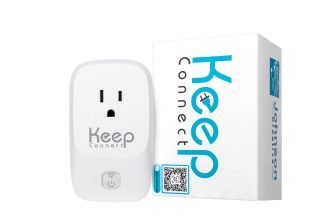
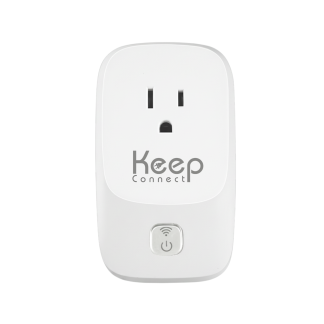
PowerPal monitors whether power is present at the outlet where it is plugged in. While it has power, it sends a regular heartbeat to Keep Connect servers. When the power fails, the heartbeat stops and the servers send a free text or email. You get another when power returns. It works even when the outage also takes down your WiFi. No app or electrician is needed.
PowerPal does not measure watts, kilowatt-hours, AC runtime or operating cost. It also cannot confirm that the air conditioner is running, or detect a thermostat, refrigerant or compressor failure while outlet power remains available. For more ways to get alerted when the power fails, see our power failure alarm guide.
Frequently Asked Questions
How many kWh does an AC use per day?
Multiply the running watts by the hours the compressor runs, then divide by 1,000. For 8 compressor-on hours, a 1- to 5-ton central AC uses roughly 8 to 60 kWh, and a 500- to 1,500-watt window unit about 4 to 12 kWh. Measured kWh is more accurate.
How many watts does a 3-ton AC use?
A 3-ton central AC, rated at 36,000 BTU, typically draws about 3,000 to 4,500 watts while running. Check the nameplate on your unit for its exact rating.
How much does it cost to run an air conditioner?
Multiply the running watts by the hours it runs, divide by 1,000, then multiply by your rate per kWh. Count the hours the compressor actually runs, not the hours the thermostat is set to cool. At $0.18 per kWh, the examples on this page range from about $49 to $324 a month.
How do I know if my AC is using too much power?
Watch for a higher bill with no change in the weather, longer run times, rooms that never reach the set temperature, or higher daily kWh on an energy monitor. A dirty filter, leaky ducts or low refrigerant are common causes.
Can PowerPal tell me how much electricity my AC uses?
No. PowerPal tells you whether power is present at the outlet and sends a text or email when it goes out or comes back. To measure watts or kWh, use an electricity usage monitor.
Sources and Methodology
- Central AC chart: calculated as BTU per hour ÷ EER, using EER 12 (low end) and EER 8 (high end). The “about 3,000 to 5,000 watts” figure for a typical 3- to 4-ton system assumes an EER of about 10 to 12 (36,000 ÷ 12 = 3,000; 48,000 ÷ 10 = 4,800). EER definition from the U.S. Department of Energy.
- Window and portable ranges: window units of about 5,000 to 15,000 BTU at an EER near 10; portable units of about 8,000 to 14,000 BTU at an EER near 8.
- All wattage ranges: general planning estimates, not measurements of every model. Actual draw varies by capacity, efficiency, voltage, compressor design and operating conditions. Check the nameplate, EnergyGuide label or manufacturer specifications for your unit.
- Electricity price: 18.31 cents per kWh, U.S. residential average, July 2026, EIA.
- Duct losses: ENERGY STAR.
- kWh and cost formula: U.S. Department of Energy.
- Cost table: arithmetic from the formula above, at $0.18 per kWh over 30 days.